On April 3 and 4, Heerlen (The Netherlands) set the stage for the closing conference and workshop of the Smart Survey Implementation Project (SSI), funded by Eurostat and co-funded by the European Union (Grant Agreement Number: 101119594) . The goal of SSI was to draw lessons on integrating smart technologies into official statistics — not only from privacy and security perspectives, but also with a strong focus on user-centric design.
The international collaboration and knowledge-sharing brought together 45 participants from different countries, national statistics institutes (NSIs), and universities. While smart studies are clearly part of the future, and SSI’s key takeaways taught some very important lessons for future studies.
The Project
SSI was a collaboration among seven NSIs (Belgium, Germany, the Netherlands, France, Slovenia, and Norway), three universities (University of Utrecht, University of Mannheim, and the Vrije Universiteit Brussel) and one spin-off company — hbits (Belgium). The project started in May 2023 and ended 24 months later in April 2025. The results are available via this link.
Smart Surveys
Smart Surveys are revolutionizing data collection. Through mobile devices like smartphones and smart meters, traditional survey instruments such as questionnaires can easily be combined with passive data collection such as geolocation (e.g. to measure travel times), as well as relieving burdensome tasks (e.g. receipt scanning instead of manual expense entry in household budget diaries).
For years, hbits has focused strongly on integrating these innovations with the MOTUS data collection platform. During the SSI project, hbits was leader of the work package revolving around data infrastructure and the development and integration of microservices for receipt scanning and geotracking.
Following continuous refinement, both microservices are now being incorporated into various new studies.
- Geotracking is part of the Time Use Study of the WinWin4Worklife project. This is Horizon Europe project (Grant Agreement Number: 101132580) conducted in five countries (Luxembourg, Germany, Finland, Portugal and Slovakia) and focusses on the impact of Remote Work Arrangements.
- Receipt scanning will be at the center of the ‘Continuous household budget surveys’ (LWR), run by Destatis, the German national statistics institute.
Developing these microservices took joint efforts. And the SSI conference provided the opportunity to reflect critically on the advancements in the field. It also allowed to draw some conclusions which will help Smart Surveys reach their full potential. Below are some of hbits’ key insights for the success of future Smart Surveys.
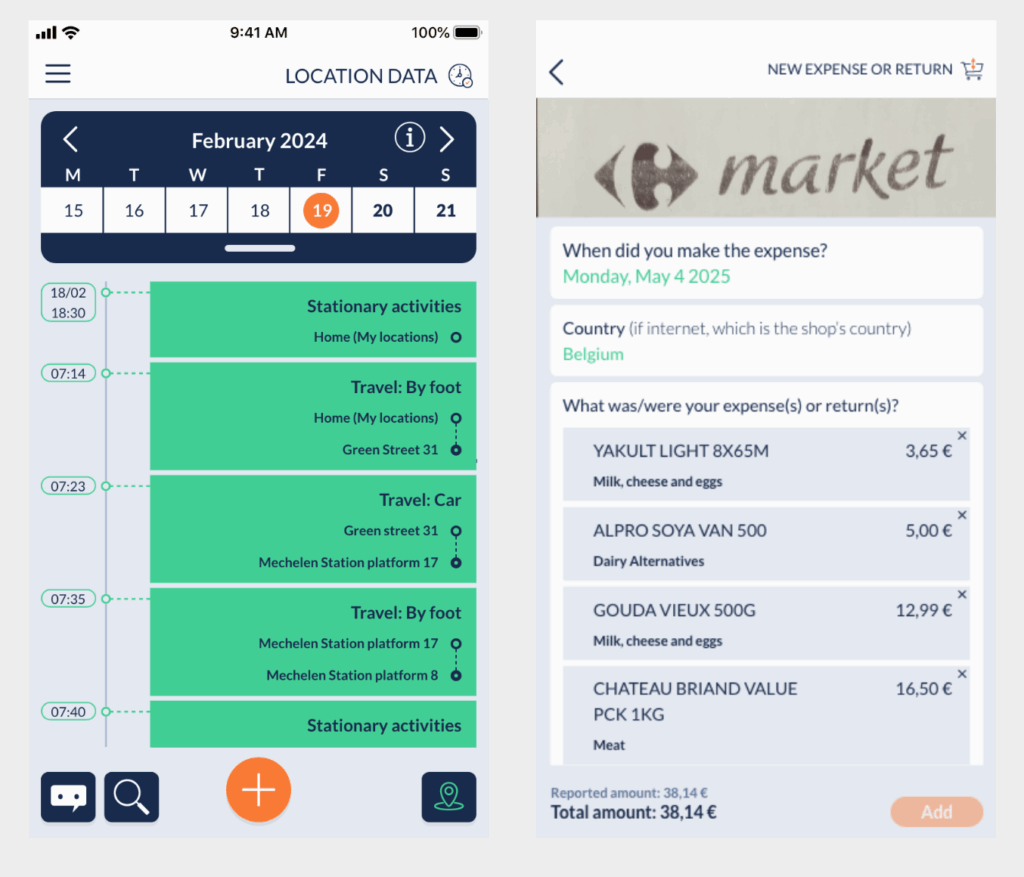
(left) The geotimeline shows respondents an overview of stationary and travel activities, which then can be used to create diary entries. (right) The ticket overview shows products and prices from supermarket ticket, after scanning and digitalizing the ticket for the respondent to verify. These two cases made use of a smart device, a processing microservice holding algorithms and were integrated with the MOTUS data collection platform for backoffice and frontoffice operations.
1. More doesn’t mean Better
It’s tempting to assume that if technology makes the road smoother, you can travel farther. Smart Surveys have made studies more accessible, more flexible to complete (at a respondent’s own time and place), and are able to make certain tasks quicker to complete. Yet, they have not necessarily made them easier for respondents.
Time Use or Budget Diaries still demand considerable time and effort, and tentative (supportive) data — such as geolocation or scanned receipts — still needs to be verified by the respondent. The illusion that “smart” automatically means “effortless” can lead to overly complex questionnaires and participant fatigue, threatening response rates and data quality.
So instead of aiming to collect more data, Smart Surveys should focus on collecting better data — more accurate, relevant, and complete — while minimizing respondent burden.
2. Smart Surveys don’t replace (human) communication
With smart technology, respondents can be reached through email, websites, notifications, etcetera. This is a time saving step forward to interviewers contacting respondents by phone, of even going house to house. Yet they should not entirely replace human contact. An easy example is that not everybody is technology-able. And you still need the time-tested methods of personal contact and guidance to reach everyone in your population.
But even for tech-savvy respondents, personalization matters. Put time in your email communication, engage with respondents, make their efforts feel valued by returning results of the study. It’s easy to write a generic thank you-mail, but it won’t keep respondents as engaged as a real person calling them to say thank you.
Another form of communication is feedback. Smart Surveys’ ability to process data in real time opens opportunities to provide instant feedback to participants on an individual basis. This is a unique opportunity for Smart Surveys to improve respondent engagement by delivering meaningful insights.
3. Technology can be frightening, privacy is key
As technology evolves, so do concerns about privacy and security. With rising public awareness of phishing, malware, and data breaches, participants are understandably cautious about sharing location data or granting access to sensors, cameras, or files.
Researchers must therefore ensure transparency about what data is collected, why it is collected, and how it is used — always giving respondents clear choices and control.
Equally important is relevance: each data request should have a clear, justified purpose. A commuting study, for example, might reasonably request location data but not camera or Bluetooth access. Such clarity helps maintain trust, which is the foundation of every successful Smart Survey.
Conclusion: Design with the respondent in mind
MOTUS is a modular data collection platform. At hbits we constantly try to find new and innovative ways in collecting impactful data. In the past years , we have created a some exciting building blocks to create studies that deliver valuable insights. But just because the tools are in the toolbox does not mean you have to use them all in your study setup.
Ultimately, the success of a Smart Survey depends on trust, communication, and sensible design choices. When used thoughtfully, these elements turn technological innovation into truly smart and impactful research.