The WinWin4WorkLife project has reached its halfway point. All partners completed their employer survey achieving impressive participation numbers. With Luxembourg and Slovakia are already presenting their preliminary findings, and Germany following soon! All studies in these countries were conducted using the MOTUS data collection platform.
The project
WinWin4WorkLife is an EU Horizon project in which fifteen partners—universities, research institutes, and others—collaborate to investigate the impact of remote work in five European regions from social, economic, and spatial perspectives. Through both an employer survey and an employee study, WW4WL aims to work with changemakers and stakeholders to use the research results to secure a sustainable role for remote work in our ever-evolving society.
Each of the five regions examines remote work from a distinct perspective:
- Luxembourg and the Greater Region: remote work in the context of the 200,000 Belgians, French, and Germans who cross the border daily to work in the Grand Duchy.
- Germany (Munich Metropolitan Region): assessing the impact of remote work on the notoriously high housing prices in the region.
- Finland (Helsinki region and South Savo): with around half a million second homes, 40% of Finns divide their time between Helsinki and a rural residence.
- Portugal (Lisbon Metropolitan Region): while ‘digital nomads’ enjoy the sunny climate combined with a comfortable income their home country, the local housing market is under pressure.
- Slovakia: exploring whether remote work can help counteract the brain drain that sees young, talented Slovaks leaving rural areas—and sometimes the country—to apply their skills elsewhere.
In each country, the study consists of three components. The employer survey explores employers’ willingness to permit remote work, as well as their views on productivity and employee mental health.
The employee study investigates the experiences and daily-life impacts of remote work among workers in both (peri-)urban and rural settings. This component includes surveys and interviews, along with two time diaries that incorporate geolocation to analyse employees’ travel times and distances.
To support both the employer survey and the employee study, hbits developed a custom WW4WL app for web and smartphone. The app is fully powered by the MOTUS data collection platform but rebranded to match the project’s visual identity. (hbits also created the WW4WL branding, logo, and website.)
This study will also mark the first large-scale European rollout of MOTUS’ geotracking functionality. The feature had previously been tested successfully during the ‘Smart Survey Implementation Project’ (SSI).

The WW4WL app is a custom-branded version of the MOTUS app.
The third component of WW4WL uses a Delphi survey and local workshops to map the broader impact of remote work on cities, rural territories, and cross-border regions. This brings together stakeholders and experts to shape a sustainable future for remote work. For this component, the WW4WL consortium works with partners including the Universidad Politécnica de Madrid (UPM).
Early results
While the employee study is currently being launched, the employer survey across the case-study regions is has been completed. In total 5,972 companies participated, with Luxembourg (LISER) and Germany (ZEW) reporting very strong participation rates. Luxembourg in particular, where 2,600 employers completed the survey, far exceeding the target of 1,000.
LISER and Trexima Bratislava have also shared early insights:
Luxembourg:
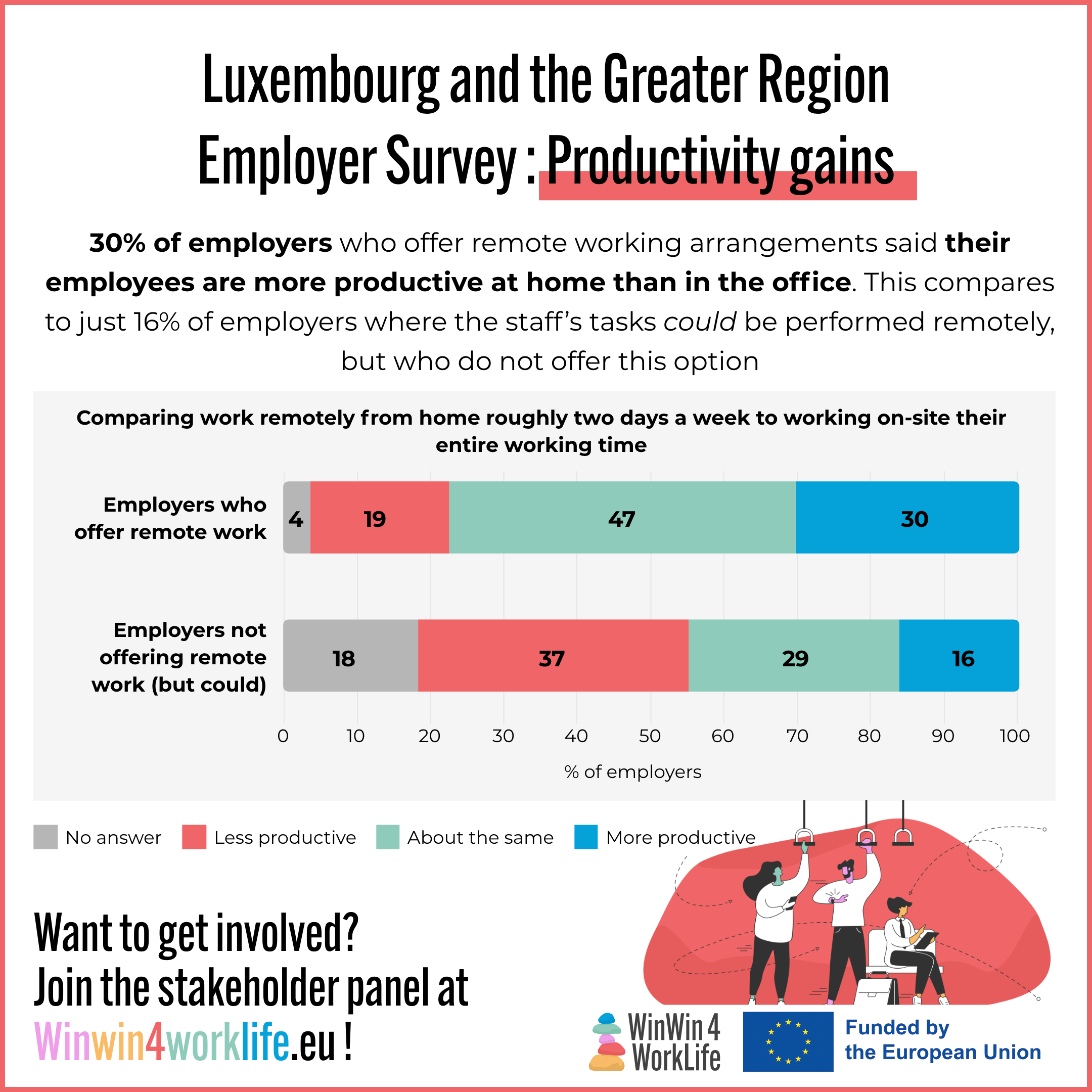
- 30% of employers who offer remote work believe it increases employee productivity, while about 19% believe the opposite. Nearly half (47%) report no effect on productivity.
- In comparison, more than 36% of employers not offering remote work are convinced productivity would decline.
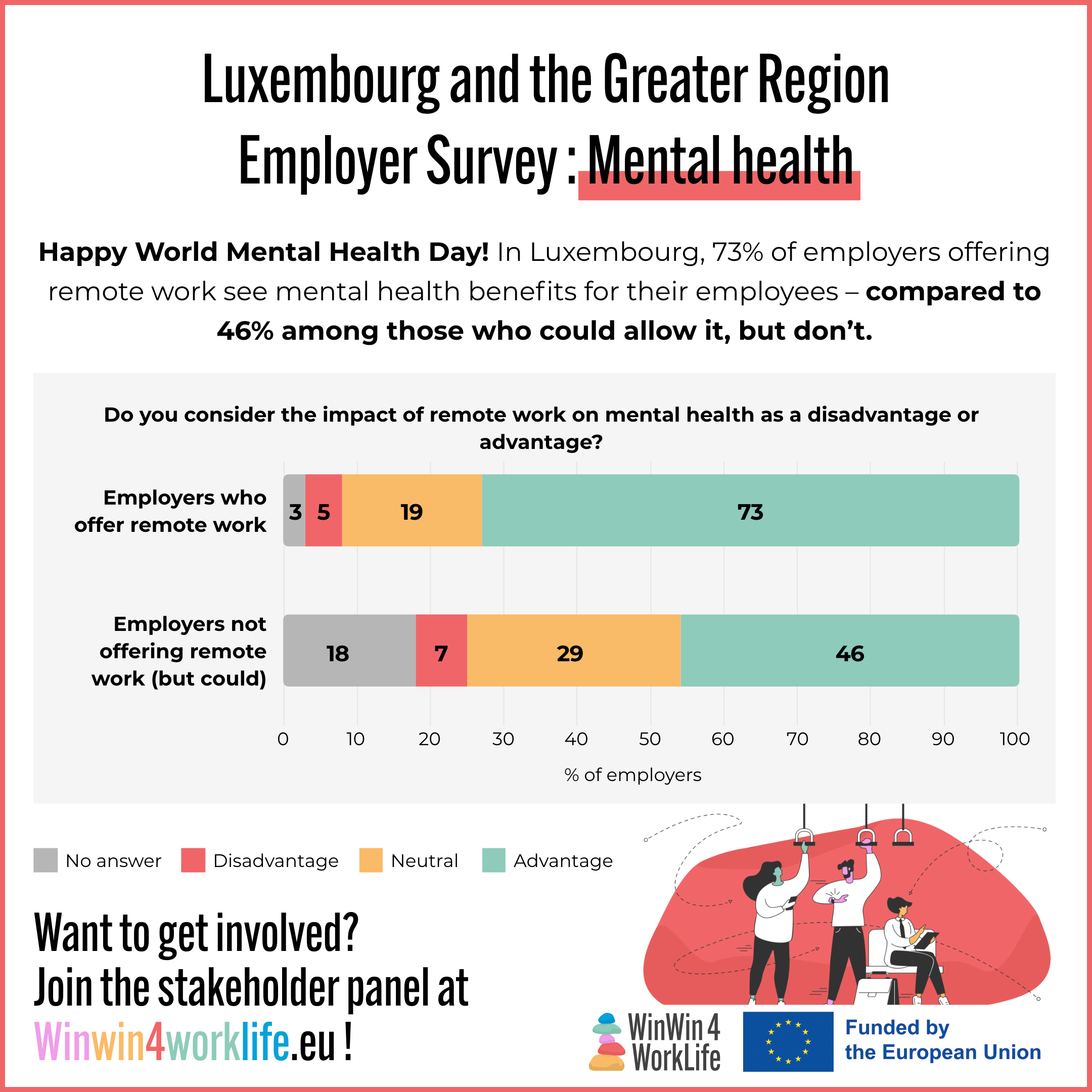
- 73% of employers who support working from home believe it has a positive impact on mental well-being. Remarkably, even 46% of employers who do not allow remote work—despite it being technically feasible—still acknowledge its mental health benefits.


Slovakia:
- Remote work in Slovakia mainly means working from home. Satellite offices, coworking spaces, or public workplaces are rarely used.
- In total, 57% of companies in Slovakia offer working from home (for at least some of their employees).
- Since the pandemic, the share of home working has increased significantly in Slovakia. The IT sector stands out, with more than 72% of employees working from home compared to 40% before the pandemic.
- Nearly seven in ten companies that allow working from home consider it an important asset for retaining staff.
- Findings on mental health are also positive: 73% of remote-friendly companies see working from home as a way to improve employee well-being, compared to 60% of companies without home-working.
- Regarding productivity, 30% of home-working companies report an increase, compared to just 16% of other companies.
- Sick leave also shows a significant improvement with home working—only 38%, compared to 53% at companies that do not offer home-working.
- Of the employers that currently do not offer working from home, 64% expect they will also not offer it in the next five years.
The full article on the results from Slovakia can be read here (Slovak):
‘Ako sa na Slovensku využíva home office?’ – Michal Hrnčiar (Analytik, Trexima Bratislava)
For more information about WinWin4WorkLife, or to participate in the stakeholder panel, visit: https://winwin4worklife.eu